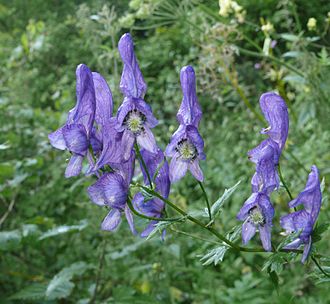
Aconite (aconitum napellus) also known as: monkshood, wolfsbane, leopard’s bane, mousebane, women’s bane, devil’s helmet, queen of poisons, or blue rocket. “The name aconitum comes from the Greek ἀκόνιτον, which may derive from the Greek akon for dart or javelin, the tips of which were poisoned with the substance, or from akonae, because of the rocky ground on which the plant was thought to grow. The Greek name lycoctonum, which translates literally to “wolf’s bane“, is thought to indicate the use of its juice to poison arrows or baits used to kill wolves.[8] The English name monkshood refers to the cylindrical helmet, called the galea, distinguishing the flower.”
Poisonous & a potent neurotoxin & cardiotoxin. As little as 2 mg or 1g of it, could cause death from paralysis of the respiratory system or cardiac muscle. Even small contact with its flowers Could cause the fingers to become numb.
In Witchcraft: Protection, Invisibility, consecrate the athame or ritual knife, an infusion with the leaves or root to banish prior energy from magickal blades & infuse with protection, burn root or leave as incense, the fresh flowers & make a tincture that will refresh the power of the knives, magickal wash infusion for ritual tools or sacred space. watchfulness against negative energies in ritual, wash a new cauldron in the infusion, burn aconite in cauldron’s first fire, invoke Hecate, poison arrow tips, & cure for werewolves.
Small History?: “Believed by the ancient Greeks to have arisen in the mouths of Cerberus while under the influence of Hecate. It later was noted as one of the ingredients of the ointment that witches put on their body in order to fly off to their sabbats. In “Dracula” (Spanish, 1931), aconite was substituted for garlic as the primary plant to repel the vampire.” (Source Number 4).
Sources:
1.) https://en.wikipedia.org/wiki/Aconitum
2.) https://www.drugs.com/npp/aconite.html
3.) https://witchesofthecraft.com/tag/aconite/
4.) “The Vampire Book” – by: J. Gordon Melton – 1999 – Visible Ink Press – pg. 3
 StarWolf Geek